
Mastering Modular Construction: Design, Connection, and Assembly
C-HUB
About This Course
This course is designed for undergraduate students and fresh graduates in civil engineering who want to learn the fundamentals of modular building connections. It is suitable for beginner to early-intermediate learners who have basic knowledge of structural concepts and are interested in understanding modular construction systems more deeply.
Participants will explore various types of module connections, fundamental structural behaviors, and assembly sequences that are essential for successful modular project implementation. The course emphasizes conceptual understanding as well as practical insight to build a strong foundation in modular construction.
Aim of Study:
This course aims to equip undergraduate students and fresh graduates in civil engineering with essential foundational knowledge and practical insights into modular building systems, focusing specifically on three critical areas: design, connection, and assembly.
Scope of Study Materials:
Learners will gain access to a comprehensive set of curated learning resources, including:
- Illustrated lecture videos and reading materials
- Module types and structural considerations
- Detailed examples of intra-, inter-, and foundation-level modular connections
- Step-by-step animations and visualizations of the assembly process - Interactive quizzes and self-assessments at the end of each module
Technologies to Be Used:
- Learning Management System (LMS) for hosting content and tracking learner progress
- Video-based instruction with annotated diagrams and animations
- Digital handouts and PDF guides for offline reference
Learning Objectives:
By the end of this course, participants will be able to:
- Understand the principles and benefits of modular construction compared to conventional construction methods.
- Identify and classify different types of modular building systems and their applications in various construction contexts.
- Analyze structural considerations in modular design, including load transfer, stability, and alignment.
- Differentiate and evaluate various types of module connections, including intra-module, inter-module, and module-to-foundation connections.
- Visualize and describe the modular assembly process, both off-site (fabrication) and on-site (installation).
Requirements
To successfully participate in this course, students are expected to have:
-
Basic knowledge of structural mechanics and structural analysis
-
Fundamental understanding of construction materials (especially steel and concrete)
-
Introductory knowledge of building construction methods
-
Ability to read and interpret engineering drawings whether in 2D or 3D
-
Basic analytical and problem-solving skills
-
Willingness to engage in technical discussions and collaborative learning
Course Staff
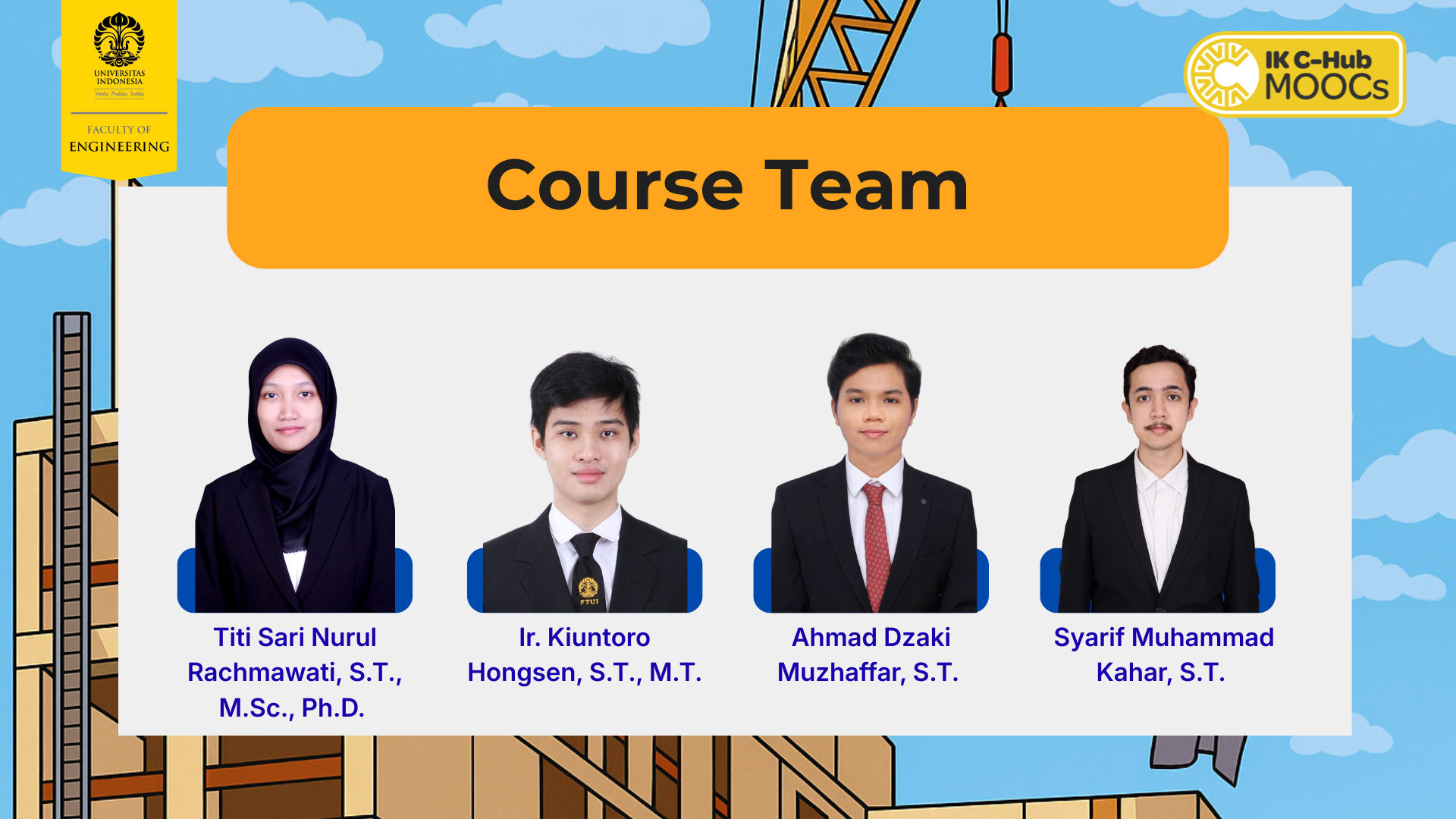
Titi Sari Nurul Rachmawati, S.T., M.Sc., Ph.D. – Lead Instructor (titisari.nurul@gmail.com)
Titi Sari is a faculty member at the Department of Civil and Environmental Engineering, Faculty of Engineering, Universitas Indonesia. She specializes in sustainable construction and innovative building systems, and currently leads this course as the main instructor.
Ir. Kiuntoro Hongsen, S.T., M.T. – Structural Expert (kiuntoro@gmail.com)
Kiuntoro is a Civil Engineering graduate from Universitas Indonesia with extensive experience in various infrastructure projects. He brings deep expertise in structural engineering to guide learners through the technical aspects of modular construction.
Ahmad Dzaki Muzhaffar, S.T. – Lead Developer for Modular Construction Visualization (ahmad_dzaki@outlook.com)
Dzaki conducted his undergraduate thesis research on modular construction connections using BIM and AR technology. He plays a key role in creating the visualization content that supports this course.
Syarif Muhammad Kahar, S.T. – Lead Developer for Modular Construction Visualization (syarifkahar.sk@gmail.com)
Syarif also focused his undergraduate thesis research on modular construction connections using BIM and AR technology. He contributes to the course by developing detailed and interactive visualizations to enhance learner understanding.